
In honor of Black History Month, the Edison Awards celebrates the untold stories of alliance and collaboration that shaped the civil rights movement, and how they parallel the innovation partnerships we honor today.
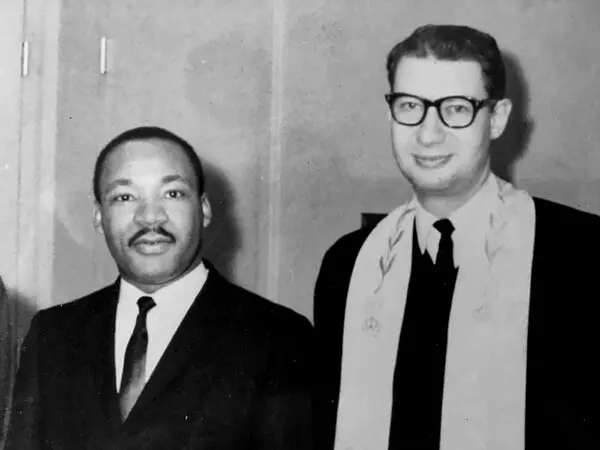
When journalist and filmmaker Avi Dresner recently spoke to the Latimer Fellowship Program, he drew a powerful parallel that resonates deeply with the Edison Awards’ mission: just as Lewis Latimer was essential to Thomas Edison’s groundbreaking work, Rabbi Israel “Sy” Dresner was a crucial ally to Dr. Martin Luther King Jr. in the fight for civil rights. Both stories remind us that transformative achievements, whether in technology or social justice, are never the work of individuals alone.
“Nobody does it alone,” Avi told the fellows. These aren’t “savior stories,” but examples of “game recognizing game,” or a mutual recognition of each other’s contributions and a commitment to shared goals that transcend individual acclaim.
A Legacy Born from Tragedy
Rabbi Dresner’s journey toward civil rights activism began in tragedy. Born in 1929 in a Manhattan tenement to East European immigrant parents, one of his earliest memories at age four or five was hearing Hitler speak on the radio while his father wept. Young Sy understood, even then, what would happen to their family in Europe. His father would eventually lose over 30 first cousins in the Holocaust.
Raised with strong Jewish values, Dresner internalized the commandment “justice, justice shall you pursue” and the Torah’s repeated reminder to “remember the stranger, for you were strangers in the land of Egypt,” a phrase that appears 36 times in Jewish scripture. His first arrest came at age 18, during a sit-in protesting Britain’s refusal to allow Holocaust survivors into Palestine. When his mother said it was “a shame for a Jewish boy to get arrested,” he responded with pride, the first sign of the moral courage that would define his life.
The Freedom Rides: Where It All Began
In June 1961, Rabbi Dresner participated in the very first interfaith clergy Freedom Ride from Washington, D.C. to Tallahassee, Florida. The group of 18 (four Reform rabbis and 14 Protestant ministers) faced immediate danger. In Tallahassee, ten members were arrested at an airport restaurant when the manager locked the door, claiming they were “closed.” While in jail, other white prisoners set their mattress on fire.
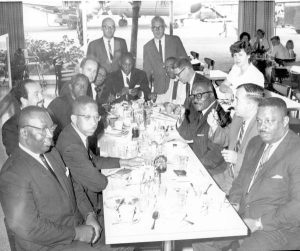
This arrest became Dresner et al. v. City of Tallahassee, the first Freedom Rider case to reach the Supreme Court, with Rabbi Dresner as lead defendant. Three years later, as the Civil Rights Act had passed, the “Tallahassee 10” returned to complete their sentences, but this time they could eat in the same airport restaurant where they had been arrested. A photograph captured this powerful moment of progress.
Meeting Dr. King Under Unfortunate Circumstances
Rabbi Dresner and Dr. King first met in August 1962, shaking hands through jail cell bars in Albany, Georgia. This was before King’s major victories, as the Birmingham campaign was eight months away, and the a year to the day before the March on Washington. At Dr. Anderson’s home in Albany, surrounded by the White Citizens Council (described as “the Klan without the hoods”), King spent an hour calming the anxious rabbi with conversation.
During that conversation, King shared his admiration for how Jews celebrated being descendants of slaves, not just kings—building a whole holiday around this identity. Dresner’s response was sobering: Jews had been slaves by the millions less than 17 years prior in Nazi concentration camps. This wasn’t ancient history; it was living memory.
King asked Dresner to recruit clergy for what would become the largest mass arrest of clergy in U.S. history, 75 clergymen arrested in Albany. On January 18, 1963, King delivered what was possibly his first sermon during an actual Shabbat service at Rabbi Dresner’s synagogue in Springfield, New Jersey.
St. Augustine: The Turning Point
In 1964, Dr. King sent a letter from jail in St. Augustine, Florida, calling it “the most lawless community in which we have ever worked,” describing shootings, beatings, and house burnings. He specifically requested that Dresner bring a “task force from the reform movement” to witness for “self-respect and human dignity.”
Rabbi Dresner recruited 16 rabbis, the largest arrest of rabbis in U.S. history. When they entered a mass meeting, King announced “Moses’ children are here” and called Dresner to the pulpit. Dresner spoke so long that the other rabbis shouted “Genug!” (enough!) in Yiddish to get him to stop.
The rabbis’ arrest at the Munson Motor Lodge created a strategic diversion: while they were arrested at the front entrance, activists integrated the pool in the back. The hotel owner’s response—pouring muriatic acid into the pool while swimmers were still in it—made the front page of the New York Times. That single photograph helped break the Senate filibuster and led to passage of the Civil Rights Act.
From jail, the rabbis wrote a letter explaining their motivations: “We came because we knew that second only to silence, the greatest danger to man is loss of faith in man’s capacity to act. We came as Jews who remembered the millions of faceless people who stood quietly watching the smoke rise from Hitler’s crematoria.” This powerful statement will serve as a framing device in the upcoming documentary “The Rabbi & The Reverend,” read by prominent Americans including Senator Cory Booker, Congressman James Clyburn and Congresswoman Debbie Wasserman Schultz.
Selma and Beyond
Following Bloody Sunday on March 7, 1965, Dr. King called for a “ministers’ march” two days later. Of all the clergy present at the foot of the Pettus Bridge, King asked only two people to deliver the prayer: Rev. Ralph Abernathy and Rabbi Dresner. They didn’t know King would turn them around after the prayer—Dresner was prepared to face the same troopers who had beaten activists just 48 hours earlier.
The partnership continued until King’s final year. They saw each other one last time in 1967 when King spoke against the Vietnam War at Riverside Church, exactly one year before his assassination. King inscribed his book “Where Do We Go From Here?” to “my good friend, Si Dresner, for whom I have great respect.”
A Forgotten Alliance
The Black-Jewish partnership that Rabbi Dresner embodied was once central to American progress but has largely been forgotten. At the turn of the 20th century, Julius Rosenwald, president of Sears Roebuck, and Booker T. Washington founded over 5,000 schools that educated two-thirds of African American children in the South, including future civil rights leaders like Maya Angelou. Jewish organizations helped fund the early NAACP. This history of solidarity deserves to be remembered and revived.
Bending the Arc Together
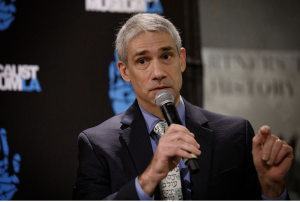
Avi Dresner shared a profound insight during his presentation: “The arc of the moral universe bends toward justice, but the arc of human civilization bends toward innovation, and both require people to actively bend them.” Unlike technology, which progresses linearly, social progress can go backwards without constant vigilance. Rights we now take for granted—integrated dining, transportation, housing—were crimes during the civil rights era and required tremendous sacrifice to achieve.
This message resonates powerfully with the Edison Awards’ mission and the Latimer Fellowship Program. Just as we celebrate innovation and the partnerships that make it possible, we must remember that progress in any field requires allies who recognize each other’s contributions and work together toward shared goals.
The documentary “The Rabbi & The Reverend,” currently in production with Avi Dresner as executive producer, will bring this crucial story to wider audiences. Rabbi Dresner and Avi are also featured in the third episode of Henry Louis Gates Jr.’s PBS series “Black and Jewish America: An Interwoven History,” airing February 17th.
As we honor Black History Month, let us remember that the greatest achievements in innovation and justice alike require us to stand together, recognize each other’s contributions, and actively bend the arc toward a better future, because nobody does it alone.
Learn more about the Latimer Fellowship Program and its mission to support diverse innovators at latimerfellows.com
 Discover
 Videos
 Podcasts
 Lewis Latimer Fellowship
 Sponsorships
 The Steering Committee
 Contact Us
 Edison Achievement Award
 Past Edison Award Winners Gallery