From IBM Watson to AI Agents: What 40 Years of Edison Awards Winners Reveal About Enterprise Technology

Software used to wait for instructions. Now it acts on its own. The Edison Awards saw every step coming.

Every workplace runs on technology someone had to imagine first. Since 1987, the Edison Awards has named nearly 300 winners in Enterprise Technology & Software, from the NeXT Computer to Windows 95 to IBM Watson. Read the list end to end and you are watching enterprise computing evolve in time-lapse.

The latest frame is unmistakable. The category’s last two Gold winners, Adobe Acrobat AI Assistant (2025) and Cisco’s AI Assistant for Support (2026), are both generative AI. The next wave is already here: software that doesn’t just answer, but acts.

Nearly 40 years in one time-lapse

Each era of enterprise computing shows up in the winner list before it shows up on every desk. Mainframes gave way to the PC, the PC to the cloud, the cloud to mobile. Now software is giving way to software that acts on its own.

The shift that matters most for leaders: software stopped being something people operate and became something that works alongside them.

The value gap: everyone has AI, few are winning with it

Adoption is no longer the hard part. 59% of organizations moving forward with AI already run it in production, yet only 16% report a high degree of measurable value (HBR Analytic Services / Appian, 2026).

Most organizations are stuck in the middle: AI helps a little, but rarely moves the business.

The agent wave raises the stakes in both directions:

  • 40% of enterprise apps will feature task-specific AI agents by the end of 2026, up from under 5% in 2025 (Gartner).
  • $450B+: agentic AI’s projected share of enterprise app software revenue by 2035, about 30% of the market (Gartner, best case).
  • 40%+ of agentic AI projects will be canceled by the end of 2027 over cost, unclear value or weak risk controls (Gartner via New Electronics).
  • ~130 of the thousands of vendors marketing “agentic AI” offer the real thing, by Gartner’s estimate.

The gap between hype and impact is exactly where Edison winners live.

What the winners do differently

Nearly four decades of winners point to three habits worth stealing:

  1. They live inside the workflow. Watson, Acrobat AI Assistant and Cisco’s support assistant all meet people where work already happens. The HBR data agrees: AI pays off when it is embedded in core processes, not bolted on.
  2. They solve a measurable problem. The strongest entries prove impact in hours saved, cases resolved or errors avoided. Gartner’s advice for agents is the same: pursue them only where value is clear.
  3. They arrive early, not loud. NeXT and Watson were recognized before their ideas went mainstream. The next Gold winner is likely shipping right now, quietly.

Your move: the 2027 Edison Awards

Built something that turns technology from pilot to payoff? Put it in front of the judges.

  • Deadline: nominate by Dec 15, 2026
  • Eligible: products and services launched between January 2025 and January 2027
  • Category: Enterprise Tech & Software, alongside the full slate of Edison categories

The next name on the list after Watson, Acrobat and Cisco could be yours. Start your nomination →
Find out what category to choose →

Edison Labs Recap: Fitting Bigger Intelligence into Smaller Footprints

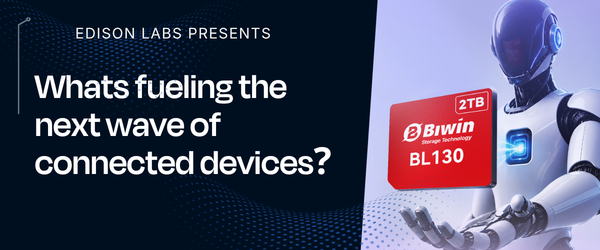
AI is about to change every connected device, and memory and storage will decide whether those devices keep up. That was the message from Bob Snyder of BIWIN, a 2026 Edison Award winner, in our latest Edison Labs webinar. His talk followed one chain: AI needs data centers, data centers need data, and bigger data demands smaller, smarter devices.

It starts with data centers

AI “is held back by the lack of sufficient data centers,” Bob said. The U.S. has almost 3,500, with 378 under construction and 1,000+ planned, and they are getting bigger: Meta’s largest is 105 acres, while its AI-era successor is planned at 960, nine times larger.

Data is outrunning our numbers

In 1991, data scientists coined the zettabyte and yottabyte because humanity had outrun its number systems. One zettabyte holds 250 billion HD movies, and the yottabyte era is expected to last half as long.

The driver is AI’s shadow: robots and industrial systems. Robot production could climb from 100,000 units a year to millions. Bob estimated that roughly 70% or more of the world’s data will soon come from machines, not people.

Bigger data needs smaller tech

AI can’t live solely in the cloud, but the edge is brutal: tiny batteries, zero airflow and millimeters of space. Edge devices need zero latency and bandwidth optimization, filtering locally and sending the data center only what it needs.

Three bottlenecks and the missing piece

The best AI algorithm in the world stays on the drawing board if the storage can’t fit or feed it fast enough. Bob named three bottlenecks: constant reads and writes, the power trap (every processor wake-up drains the battery) and the thermal wall (more processing means more heat). Memory and storage are what BIWIN calls the missing piece.

The proof: two products that shrink the problem

With modern chips, “you no longer have to sacrifice performance for form factor.” BIWIN’s ePOP5X stacks DRAM and storage into one thumbnail-sized package that saves 75% of the space for device makers. The Mini SSD, the 2026 Edison Award winner, delivers full-size SSD performance in a coin-sized, swappable drive and was named one of TIME’s Best Inventions of 2025.

Every device gets rethought

Bob closed with devices from IFA Berlin, from a cocktail robot to a food-scanning necklace to a camera that verifies its footage isn’t AI. Every digital device must now move to AI, as everything analog once moved to digital. His advice: audit your whole portfolio, plan for more memory and storage, and don’t become an industry dinosaur.

Asked what the Edison Award meant for his team, Bob said BIWIN mostly lives inside other companies’ products and is bound by NDAs, so it can’t name the famous gadgets it powers. The recognition of the Edison Award lets BIWIN be seen for its innovation, and he hopes it puts the company on the radar of medical, industrial and other device makers who will need manufacturing partners ready for AI.

Want more conversations like this? Find upcoming Edison Labs webinars at edisonawards.com/events or click HERE to view the video of this insightful webinar with Bob Snyder of BIWIN Storage.

Nominations for the 2027 Edison Awards are open through December 15. Download our Nomination Guide here. 

Ready for Nomination Season?

Complete the form below to download the 2027 Nomination Guide.

From IBM Watson to AI Agents: What 40 Years of Edison Awards Winners Reveal About Enterprise Technology
The Future of the Grid – Panel Discussion 2024 Edison Awards
2026 Edison Awards in the News