
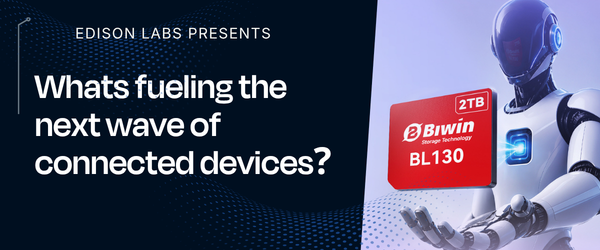
AI is about to change every connected device, and memory and storage will decide whether those devices keep up. That was the message from Bob Snyder of BIWIN, a 2026 Edison Award winner, in our latest Edison Labs webinar. His talk followed one chain: AI needs data centers, data centers need data, and bigger data demands smaller, smarter devices.
It starts with data centers
AI “is held back by the lack of sufficient data centers,” Bob said. The U.S. has almost 3,500, with 378 under construction and 1,000+ planned, and they are getting bigger: Meta’s largest is 105 acres, while its AI-era successor is planned at 960, nine times larger.
Data is outrunning our numbers
In 1991, data scientists coined the zettabyte and yottabyte because humanity had outrun its number systems. One zettabyte holds 250 billion HD movies, and the yottabyte era is expected to last half as long.
The driver is AI’s shadow: robots and industrial systems. Robot production could climb from 100,000 units a year to millions. Bob estimated that roughly 70% or more of the world’s data will soon come from machines, not people.
Bigger data needs smaller tech
AI can’t live solely in the cloud, but the edge is brutal: tiny batteries, zero airflow and millimeters of space. Edge devices need zero latency and bandwidth optimization, filtering locally and sending the data center only what it needs.
Three bottlenecks and the missing piece
The best AI algorithm in the world stays on the drawing board if the storage can’t fit or feed it fast enough. Bob named three bottlenecks: constant reads and writes, the power trap (every processor wake-up drains the battery) and the thermal wall (more processing means more heat). Memory and storage are what BIWIN calls the missing piece.
The proof: two products that shrink the problem
With modern chips, “you no longer have to sacrifice performance for form factor.” BIWIN’s ePOP5X stacks DRAM and storage into one thumbnail-sized package that saves 75% of the space for device makers. The Mini SSD, the 2026 Edison Award winner, delivers full-size SSD performance in a coin-sized, swappable drive and was named one of TIME’s Best Inventions of 2025.
Every device gets rethought
Bob closed with devices from IFA Berlin, from a cocktail robot to a food-scanning necklace to a camera that verifies its footage isn’t AI. Every digital device must now move to AI, as everything analog once moved to digital. His advice: audit your whole portfolio, plan for more memory and storage, and don’t become an industry dinosaur.
Asked what the Edison Award meant for his team, Bob said BIWIN mostly lives inside other companies’ products and is bound by NDAs, so it can’t name the famous gadgets it powers. The recognition of the Edison Award lets BIWIN be seen for its innovation, and he hopes it puts the company on the radar of medical, industrial and other device makers who will need manufacturing partners ready for AI.
Want more conversations like this? Find upcoming Edison Labs webinars at edisonawards.com/events or click HERE to view the video of this insightful webinar with Bob Snyder of BIWIN Storage.
Nominations for the 2027 Edison Awards are open through December 15. Download our Nomination Guide here.

 Discover
 Videos
 Podcasts
 Lewis Latimer Fellowship
 Sponsorships
 The Steering Committee
 Contact Us
 Edison Achievement Award
 Past Edison Award Winners Gallery